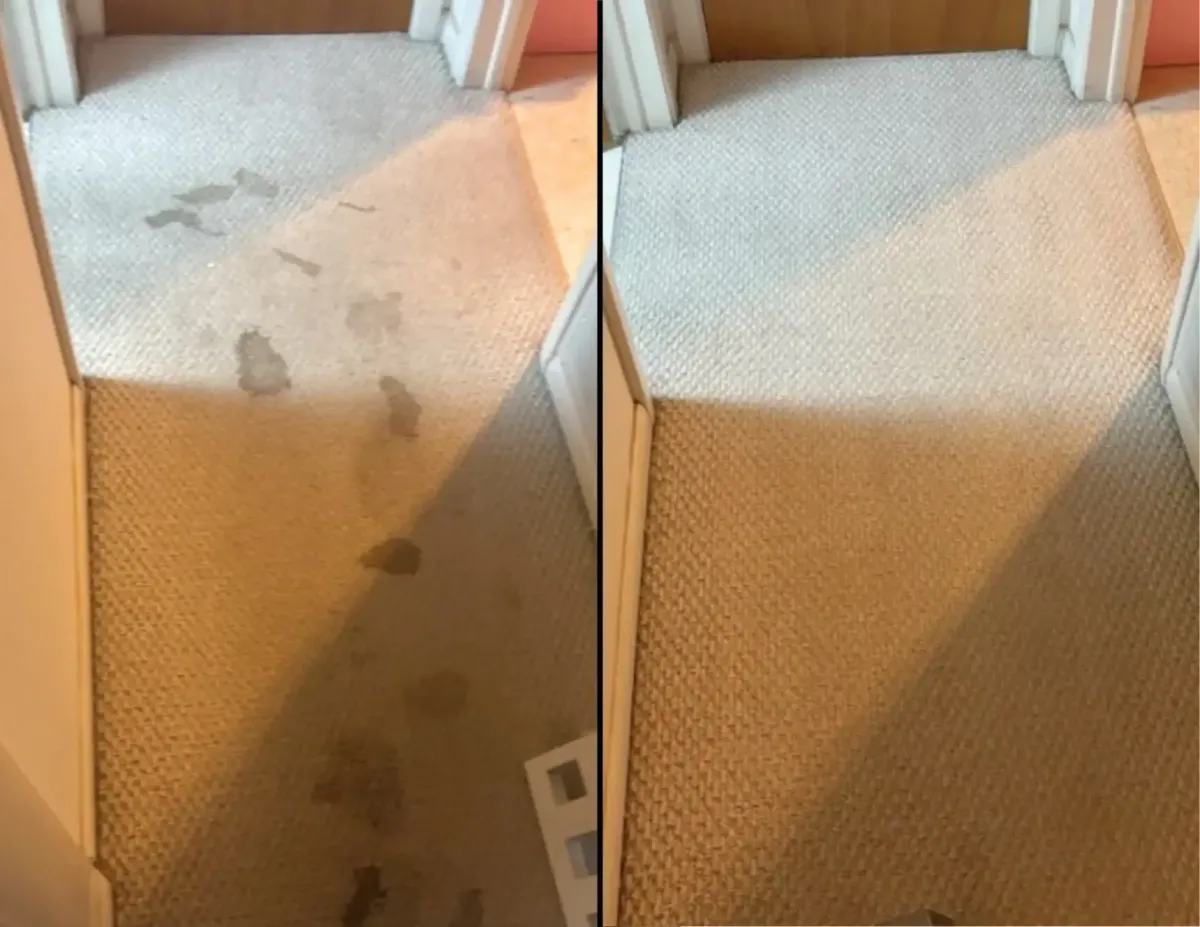
Pet Urine Foam Core: When Carpet Padding Needs Replacement
Pet Urine Foam Core — Why Replacing the Cushion Matters
Not every pet urine job ends with a cleaning. Some end with a conversation about tearing out the padding — and after 23 years of making that call, we've settled on a test simple enough to explain in one sentence but reliable enough to trust every time.
The Test We Actually Use
We base it on what happens when we walk on the carpet. If we step down and water visibly comes up over the sides of our shoes, that's not a "clean it and move on" situation — that's saturation heavy enough that the pad has to be replaced. The other trigger is contamination depth: if pet urine has soaked all the way through the padding and into the subfloor itself, cleaning the surface carpet doesn't touch what's happened underneath, and the pad comes out. Short of those two thresholds, the padding can usually be saved with the right treatment. Past them, no amount of surface cleaning changes the outcome.
Why Not Just Clean Everything and See?
Because carpet padding is foam — an open-cell structure that absorbs and holds liquid the way carpet fiber never does. Once urine has saturated the pad to the point it's visibly pooling under foot pressure, or has migrated all the way through to the subfloor, the contamination isn't sitting where cleaning chemistry and extraction equipment can reliably reach it anymore. Attempting a standard clean on padding at that stage typically just pushes moisture and bacteria around rather than removing it, and the odor returns — often worse, because now there's biological growth in play as well as the original contamination.
What Saturated Padding Actually Looks Like Underneath
![[PHOTO PLACEHOLDER: Saturated foam pad pulled back showing pet urine contamination reaching subfloor]](https://assets.cdn.filesafe.space/MYF360ivYUNrrmLbTiiA/media/6a1cbab6d7322952d16cd6b0.webp "[PHOTO PLACEHOLDER: Saturated foam pad pulled back showing pet urine contamination reaching subfloor]")
Foam padding under long-term or repeated pet contamination breaks down structurally, not just biologically. Urine's acidic and ammonia content degrades the foam's cell structure over time, so heavily saturated padding often feels spongy, compressed, or slightly crumbly when it's pulled back — a physical sign, on top of the odor and visible discoloration, that the material has passed the point of being salvageable. Once we're at that point, replacement isn't a precaution — it's the only option that actually resolves the contamination.
Frequently Asked Questions About Pet Urine Padding
How do I know if my carpet padding needs to be replaced without pulling up the carpet?
The most reliable at-home indicator is pressing down firmly on the affected area with your foot or hand — if you can feel or see moisture rising up around the contact point, saturation has likely reached a level that requires replacement rather than cleaning. Persistent odor that returns within days of a professional cleaning is another strong sign the contamination has gone deeper than the surface carpet.
Can enzyme treatment save padding that's been saturated for a long time?
It depends on how deep the saturation goes. If contamination is present but hasn't reached the level of visible pooling under foot pressure or migration into the subfloor, enzyme treatment with sub-surface extraction can often resolve it. Once saturation crosses those thresholds, enzyme treatment alone typically isn't enough because the contamination is distributed through foam that's already breaking down structurally.
Does the subfloor need to be treated separately if urine has soaked through the pad?
Yes. If contamination has reached the subfloor, the padding replacement addresses only part of the problem — the subfloor itself typically needs to be cleaned, treated, and sealed before new padding and carpet go back down, or the odor and contamination will migrate right back into the new materials.
Color Choice — What This Means for Carpet Over Replaced Padding
When padding gets replaced, the carpet on top often needs targeted spot treatment or partial re-stretching around the repair area, and that's exactly the kind of situation where carpet color choice pays off later. Mid-tone colors with pattern or fleck hide the subtle differences that can show up around a repaired or heavily-treated section far better than a solid light or solid dark color does — a solid color makes any slight variation in nap direction or treatment more visible under certain lighting. Households with pets specifically benefit from this choice, since padding replacement and targeted enzyme treatment become a recurring reality of pet ownership, not a one-time event.
Where We See This Most Often
Smoky Hill, in Centennial, has the highest concentration of pet households we see anywhere in our service area, along with Acres Green and Homestead Farm nearby — which means it's also where padding replacement conversations come up most often. It's not that the carpet or the homes are different there; it's simply a higher density of long-term pet ownership concentrated in one part of our service area, and the math on repeated accidents in the same spots eventually catches up with the padding underneath.
If you're not sure whether your carpet's padding is salvageable or needs to come out, call or text (720) 730-8055 for a free assessment, or book online at coloradochoicecarpet.com.
Serving the Front Range:Castle Rock | Highlands Ranch | Castle Pines | Lone Tree | Centennial | Littleton | Parker | Franktown | Sedalia | Larkspur | Monument | Lakewood | Morrison | Wheat Ridge | Arvada | Broomfield | Westminster | Aurora | Englewood | Thornton | Elizabeth | Denver
