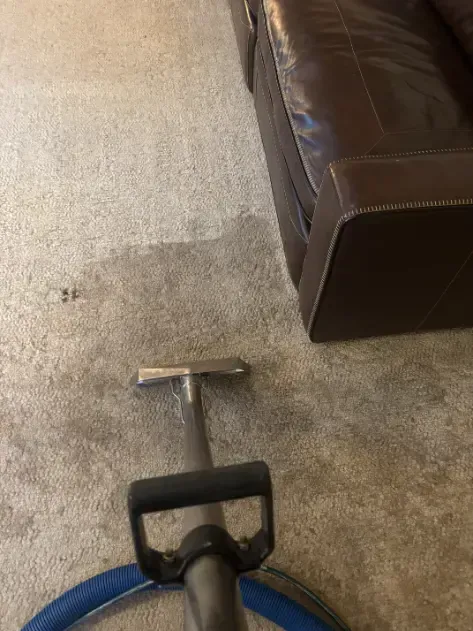
Denver Basin Hard Water: Why Carpet Feels Gritty
Why Denver Basin Hard Water Makes Carpet Feel Gritty Faster — And the Science of Why We Soften Every Gallon We Use
It's the single most common thing customers bring up on their own, without us asking: "the water here is just so hard." They're right, and it's not just a plumbing complaint — Denver Basin aquifer water rated hard to very hard is a direct factor in how fast carpet feels stiff and gritty again after cleaning. It's also the reason every unit we run is fed through a water softener before a drop touches your carpet.
What Makes Denver Basin Water "Hard"
Water hardness is a measurement of dissolved calcium and magnesium, expressed in milligrams per liter (mg/L) as calcium carbonate. The U.S. Geological Survey's standard classification puts water in one of four bands: 0–60 mg/L is soft, 61–120 mg/L is moderately hard, 121–180 mg/L is hard, and anything above 180 mg/L is classified very hard. Denver Basin aquifer water — the source running through Douglas, Arapahoe, and much of Jefferson County — consistently falls into the hard-to-very-hard range. That's not a local myth or a marketing angle; it's the same USGS scale used across the entire water treatment industry.
Why Does Colorado Have Such Hard Water?
Hardness comes from water moving through mineral-rich geology before it reaches the tap — limestone, dolomite, and calcium-carbonate-bearing rock formations dissolve into groundwater as it passes through. The Denver Basin's underlying geology is exactly that kind of formation, which is why hardness here isn't a seasonal or occasional issue — it's baked into the water source itself, every day, everywhere in our service area.
What Happens When Hard Water Meets Carpet Fiber
![[PHOTO PLACEHOLDER: Close-up of mineral buildup on carpet fiber before softened-water treatment]](https://assets.cdn.filesafe.space/MYF360ivYUNrrmLbTiiA/media/6a1cbab6d7322952d16cd6b0.webp "[PHOTO PLACEHOLDER: Close-up of mineral buildup on carpet fiber before softened-water treatment]")
Every time hard water touches carpet fiber and then evaporates or is only partially extracted, it leaves behind dissolved calcium and magnesium as a mineral residue — the same process that leaves a white haze on a shower door or spots on glassware. On carpet, that mineral residue doesn't rinse away on its own. It accumulates in the fiber with every mop, every rain-tracked shoe, every cleaning pass done with hard water, building a gritty, stiff texture that has nothing to do with dirt and everything to do with mineral deposit.
This is also why carpet cleaned with hard water can start feeling rough again within weeks, even though it was thoroughly cleaned. The soil is gone — but the water used to clean it left its own mineral signature behind.
Why We Run Every Unit on Softened Water
This is the part most companies don't talk about, and it's one of our biggest points of difference: every truckmount we run is fed through a water softener before it ever reaches your carpet. We've found over years of doing this that it makes a measurable difference in both cleaning effectiveness and how the carpet feels when we're done — and there's real chemistry behind why.
The Science of Ion Exchange
A water softener works through a process called ion exchange. Hard water is passed through a resin bed of tiny negatively-charged beads that are pre-loaded with sodium (or potassium) ions. Calcium and magnesium ions in the water are more strongly attracted to the resin than sodium is, so as hard water flows through, the resin grabs the calcium and magnesium and releases sodium ions in exchange. The water that comes out the other side has had its hardness-causing minerals swapped out — it's now soft water, chemically speaking, with dissolved sodium in place of calcium and magnesium.
Why Soft Water Cleans Better
Calcium and magnesium ions don't just leave residue — they actively interfere with cleaning chemistry while the job is happening. Hard water minerals bind with surfactants (the active cleaning agents in any detergent or pre-spray) before those surfactants ever reach the soil they're supposed to break down. That reaction forms an insoluble compound — the same "soap scum" you see in a hard-water shower — which wastes cleaning chemistry and leaves its own residue in the fiber. Soft water doesn't have those competing minerals, so the full strength of the pre-spray and detergent goes toward breaking down the actual soil in your carpet instead of reacting with the water itself.
Why It Leaves Carpet Feeling Noticeably Softer
This is the part customers notice immediately, even if they don't know the mechanism: carpet cleaned with softened water dries without a fresh layer of calcium and magnesium redeposited into the fiber. There's no new mineral crust forming as the water evaporates, which is exactly what causes that stiff, gritty feel after a hard-water clean. The fiber dries the way it actually feels when it's clean — not clean with a mineral film sitting on top of it.
FactorCleaning With Hard WaterCleaning With Softened WaterSurfactant efficiencyReduced — minerals bind with cleaning agents before they reach soilFull strength — no mineral interferenceMineral residue left in fiberYes — calcium/magnesium redeposit as water evaporatesNo — minerals removed before water reaches carpetCarpet feel after dryingStiffer, grittier over timeSofter, cleaner feelRate of re-soiling appearanceFaster — mineral film attracts and holds soilSlower — no mineral film for soil to cling to
Frequently Asked Questions About Hard Water and Carpet Cleaning
Is Denver Basin water actually classified as hard, or is that just something people say?
It's a documented classification, not just a local impression. The USGS scale rates water above 180 mg/L as calcium carbonate as "very hard," and Denver Basin aquifer water consistently falls into the hard-to-very-hard range across Douglas, Arapahoe, and Jefferson County. It's a function of the underlying limestone and mineral-rich geology the groundwater passes through before it reaches the tap.
Does every carpet cleaning company use softened water?
No — most run straight off whatever water source is available on site, whether that's a customer's hose bib or the truck's fresh water tank filled from an outdoor spigot. Softening every gallon before it reaches the carpet requires additional equipment and maintenance that not every company invests in, but it's a meaningful factor in both how well the cleaning chemistry performs and how the carpet feels once it's dry.
If my carpet was cleaned with hard water before, can softened water fix it?
A softened-water cleaning won't instantly reverse mineral buildup that's accumulated over months or years, but it stops adding to the problem and typically produces a noticeably better result than the previous hard-water cleanings, since there's no new mineral residue being deposited during the process. Carpets with heavy long-term mineral accumulation may need more than one softened-water cleaning cycle to see the full difference.
Serving the Front Range With Softened Water on Every Job
Hard water is a fact of life everywhere we serve — from Denver Basin aquifer communities in Douglas and Arapahoe County to the private well systems in Franktown, Elizabeth, and Larkspur that run even harder than municipal supply. Running every unit through a softener isn't a marketing detail — it's a decision we've made because we've seen the difference in the fiber, every single job.
Call or text (720) 730-8055 for a free assessment, or book online at coloradochoicecarpet.com.
Serving the Front Range:Castle Rock | Highlands Ranch | Castle Pines | Lone Tree | Centennial | Littleton | Parker | Franktown | Sedalia | Larkspur | Monument | Lakewood | Morrison | Wheat Ridge | Arvada | Broomfield | Westminster | Aurora | Englewood | Thornton | Elizabeth | Denver
Source: U.S. Geological Survey, Water Science School — Hardness of Water (usgs.gov)
